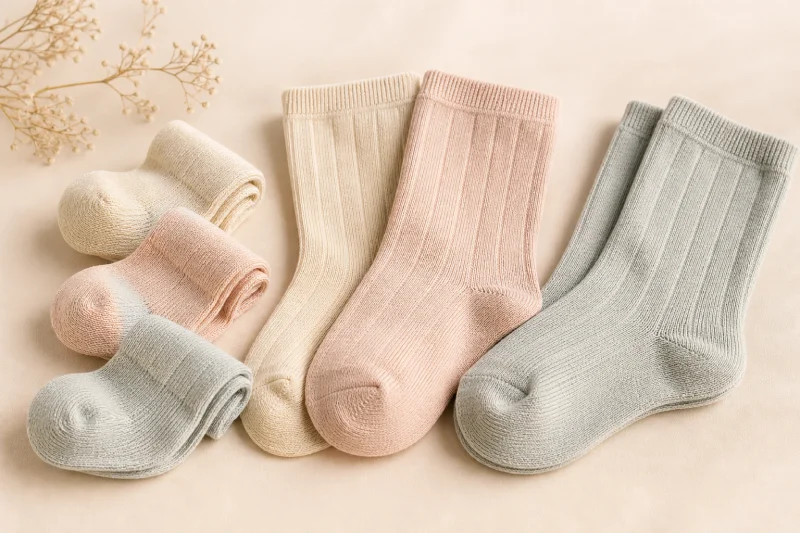
1. Raw Material: Yarn Selection for Sensitive Skin
Everything begins with choosing the most suitable touch for tiny skin.
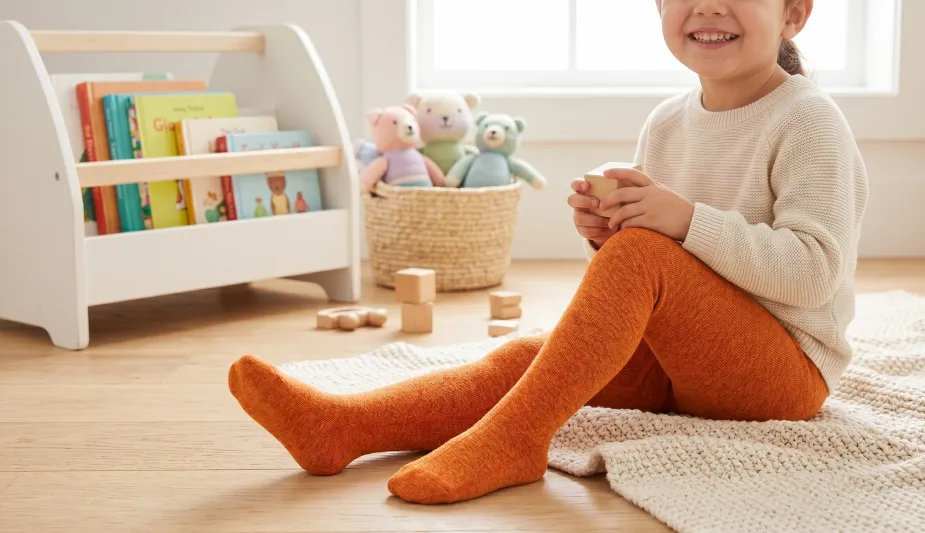
- The Most Preferred Option (20/1 Carded Yarn): Warm, full-bodied, and versatile in terms of color and pattern, this yarn is an indispensable choice for children’s tights.
- Smooth Texture (30/1 Combed Yarn): The top preference for customers seeking a finer, lighter, and more breathable construction.
- Special Requests: For brands looking for a completely organic feel, we offer custom production using hypoallergenic, ultra-soft alternatives such as Bamboo, Viscose, and Modal. High-quality elastane (spandex) is incorporated on the inner surface to provide stretch and flexibility against the skin.
2. Knitting Stage: Shaping the Legs in a Digital Environment
The leg sections of the tights are knitted first on cylinder machines specially sized for baby (96 needles) and children’s (120–132 needles) size groups. Digitally prepared patterns are woven stitch by stitch with a precise balance of elasticity, enabled by fine-gauge needles. Unlike standard socks, tights emerge from this stage as long tubes — two separate leg pieces — off the machine.
3. Garment Construction Stage: Where the Real Magic Begins
The most critical stage that makes tights “tights” is the garment construction phase. The two separate leg pieces coming off the machine are taken to the production line by our expert team:
- Cutting and Joining: The two legs are cut along their upper sections and joined together using specialized machines.
- Gusset Insertion: To allow free movement during both diapered and non-diapered use — particularly in the baby size range — an extra gusset panel is sewn into the crotch area to provide additional flexibility.
- Irritation-Free Seaming (Flatlock Stitch): To prevent redness or pressure marks on delicate skin, all joining operations are performed using smooth flatlock (flat seam) stitch technology.
- Waistband Elastic: Soft elastic bands that keep the waistband secure without constricting the child’s waist are carefully integrated into the brief section.
4. Toe Closing: Uninterrupted Comfort
The tips of the legs are closed in a way that causes no discomfort to the toes — optionally using Rosso or Seamless/Single-Row technology. At this point, the tights have taken on their complete form.
5. Washing, Robotic Boarding, and Final Touches
After garment construction, the tights are washed with softening agents in industrial washing units to achieve that final soft, plush texture. They are then placed onto specially designed tights forms for baby and children’s sizes and shaped in robotic boarding machines. In the final stage, they are packaged in your brand’s custom packaging, fitted with waistband labels, or placed into boxes and made ready for shipment.
In short: the yarn you select passes through our high-technology knitting machines and, in the skilled hands of our garment construction team, is transformed into a flawless pair of tights — ready to bring color and comfort to the world of little ones.